
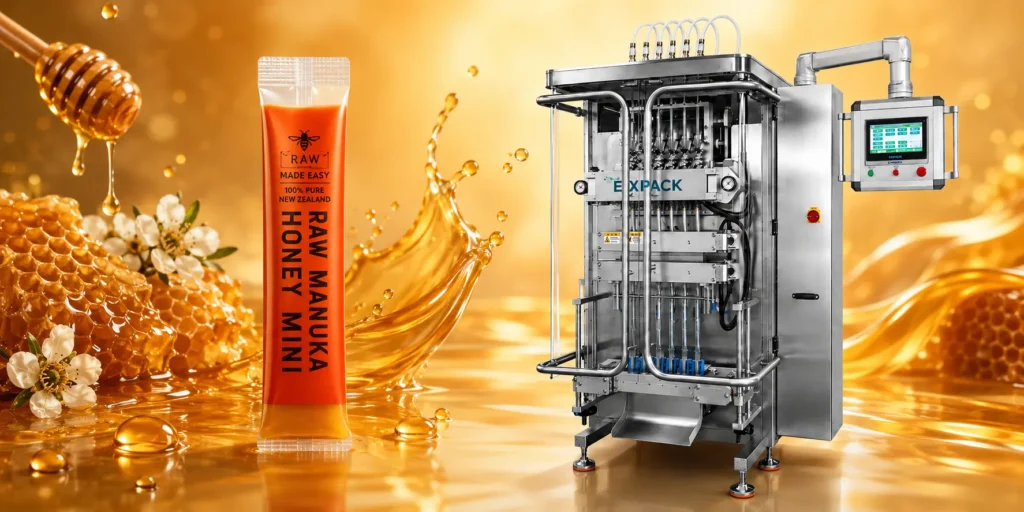
The best liquid food supplement stick pack packaging machines are not simply the models with the most lanes or the highest advertised cycle rate.
For a brand manufacturer or contract packer, the best machine is the configuration that can dose the actual formula consistently, keep sealing margins clean, produce an approved stick format, support practical cleaning, and achieve the required sellable output.
A machine that performs well with a thin vitamin liquid may need a different pump, nozzle, temperature strategy, or speed for Mānuka honey or an energy gel.
EIXPACK’ for liquid food supplement stick pack packaging machines covers liquid vitamins, liquid probiotics, liquid collagen supplements, energy gels, Mānuka honey, pharmaceutical syrups, and related liquid or gel-like products.
These applications share the stick-pack concept, but their flow behavior and packaging risks are not interchangeable.
What Makes a Liquid Stick Pack Machine the Best Fit?
A suitable liquid stick pack machine should be selected from the product outward.
Begin with viscosity at the real filling temperature, suspended particles, how quickly the product stops flowing, target dose, stick dimensions, film structure, required output, and cleaning method.
Viscosity alone does not tell the whole story. Two products with similar readings may behave differently in tubing, under temperature changes, or at the filling nozzle.
Honey may form a thread after dosing, while a thin vitamin liquid may drip quickly.
Representative sample testing is therefore more reliable than selecting equipment from a product name or one viscosity number.
Product application |
Main packaging concern |
Configuration priority |
|---|---|---|
Liquid vitamins | Fast flow and dripping | Precise pump control and clean shut-off |
Liquid probiotics | Hygiene and formula sensitivity | Short, accessible product path |
Liquid collagen | Formula-dependent viscosity | Sample-based pump selection |
Energy gels | Stringing and seal contamination | Positive displacement and anti-drip control |
Mānuka honey | High viscosity and temperature sensitivity | Stable dosing and controlled cut-off |
Pharmaceutical syrups | Dosing, records, and regulatory requirements | Project-specific documentation planning |
Choose the Pump According to Product Behavior
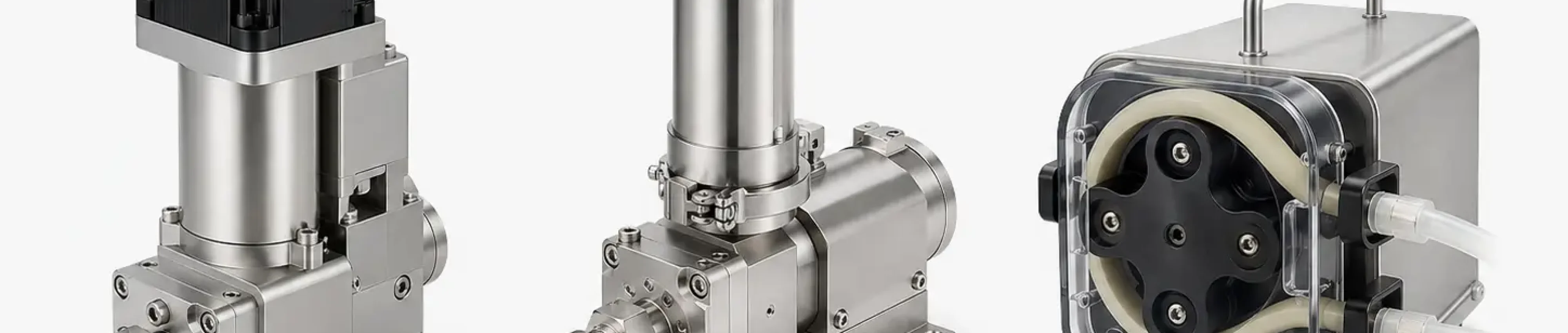
The filling pump is one of the most important decisions in an automatic liquid stick packing machine. Servo ceramic pumps, piston pumps, and peristaltic pumps can all be appropriate, but they solve different problems.
A servo ceramic pump provides controlled volumetric dosing and can be considered for syrups, supplements, honey, and gel-like materials.
In EIXPACK’s Mānuka honey stick pack project in New Zealand, an eight-lane machine used servo ceramic pumps for a high-viscosity product prone to dripping, product trapping, and stringing.
The project used round-corner stick packs and operated at 240 sticks per minute under the tested project conditions.
A piston pump is often evaluated for viscous products requiring positive displacement, including energy gels and concentrated syrups.
The piston diameter, stroke, valve arrangement, and nozzle response must match the product.
Poor matching can create pressure variation, product tailing, or excessive residue.
A peristaltic pump keeps the product mainly inside flexible tubing.
It may suit certain low-volume or hygiene-sensitive products, but tube compatibility, wear, flow rate, and dosing repeatability must be tested with the real formulation.
The EIXPACK liquid stick pack machine product page presents configurable pump and multilane packaging directions for liquid, syrup, and nutritional gel applications.
Pump selection should come from sample results rather than from the product category alone.
Prevent Dripping, Stringing, and Contaminated Seals
Liquid stick packs often fail because product reaches the sealing area before the jaws close.
Even a small amount across the seal margin may create a channel, an incomplete seal, or visible contamination.
Sticky products may also stretch from the nozzle to the film and become trapped in the top seal.
The pump, nozzle, bag length, film movement, and sealing timing must work as one process.
Depending on the product, the solution may use controlled pump deceleration, a shut-off nozzle, suck-back action, an adjusted nozzle position, or more time for the dose to separate cleanly.
The New Zealand Mānuka honey project illustrates this challenge.
The machine included stick forming, sealing, cutting, discharge, and laser coding functions, while the servo ceramic pump system was selected around the honey’s high-viscosity filling behavior.
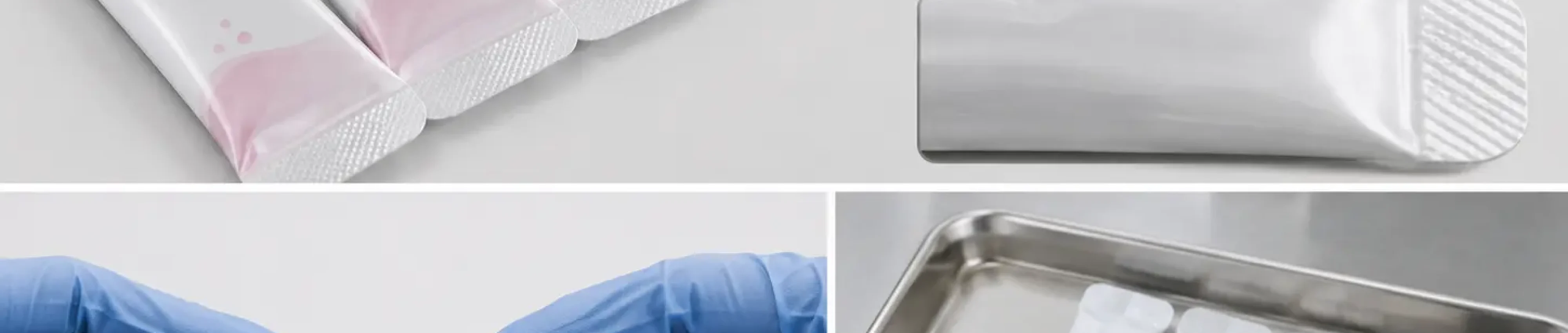
During acceptance, inspect the longitudinal seal, cross seals, tear-notch area, and cut quality.
Filled packs should be checked for contamination, leakage, deformation, and seal separation after suitable squeeze or handling tests.
On a multilane machine, collect samples from every lane.
Judge Capacity by Tested Output, Not Maximum Speed
Machine speed should be evaluated under defined production conditions. Lane count and maximum mechanical cycles do not prove the output that can be maintained with a specific liquid.
Actual output changes with fill volume, viscosity, product temperature, bag length, film structure, pump response, sealing dwell time, and downstream handling.
A 5 mL free-flowing supplement may run differently from a 30 mL gel on the same platform.
The Mānuka honey project provides a useful reference: the customized eight-lane system operated at 240 sticks per minute under its tested conditions.
This should not be treated as a universal speed for every eight-lane liquid machine.
A different formula, dose, stick length, or film may require another operating range.
Brand manufacturers should calculate capacity from monthly demand, production days, shifts, expected efficiency, and downtime.
Contract manufacturers should also include cleaning, film changes, pump adjustment, and SKU changeovers.
Sellable output over a full shift is more meaningful than a short peak-speed demonstration.
Select the Filling Volume, Stick Shape, and Film Together
Common liquid supplement fill volumes include 5 mL, 10 mL, 15 mL, 20 mL, and 30 mL.
Increasing the dose affects pump displacement, internal bag volume, headspace, bag length, and filling time.
A larger pack cannot be created only by changing a touchscreen value.
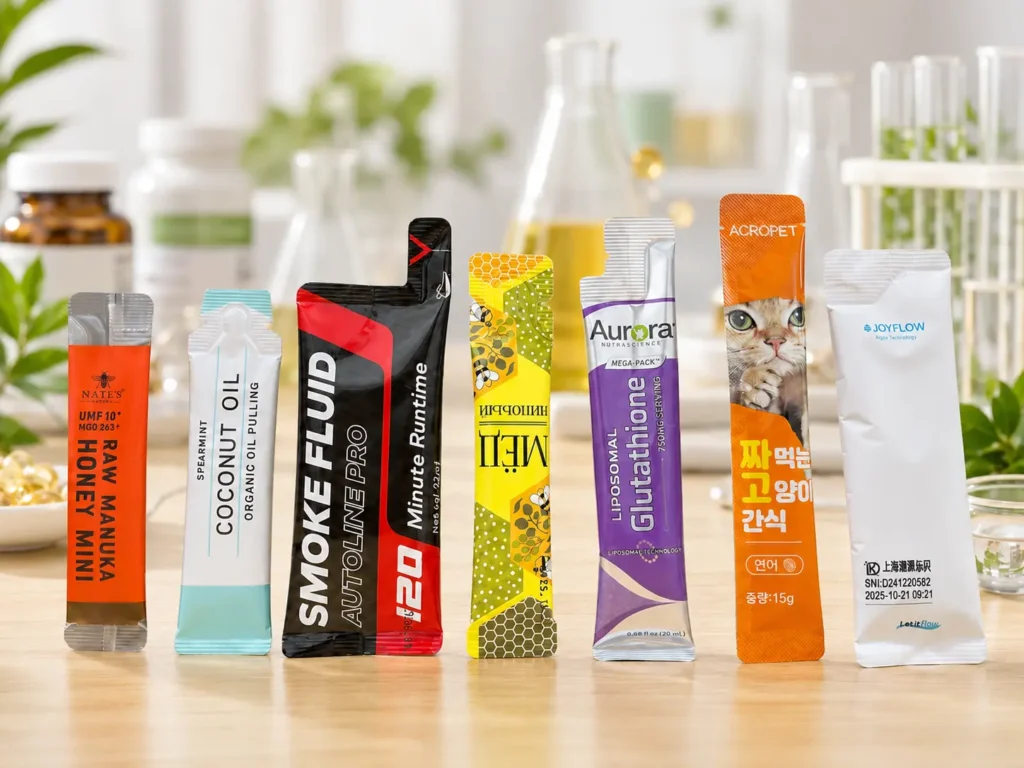
Formats may include standard straight-cut sticks, round corners, bottle-neck shapes, custom profiles, easy-tear notches, individual sticks, or connected packs.
Special shapes may require different cutting tools and can affect film use and output.
The New Zealand honey project used round-corner packs for a cleaner presentation.
Film must be evaluated for product compatibility, barrier needs, sealability, printing, and intended shelf conditions.
FDA food-contact packaging resources explain that food-contact substances include components used in packaging and other food-contact applications.
Buyers should confirm the intended use of the full film structure, inks, adhesives, and relevant materials with their packaging supplier and quality team.
Plan Cleaning and SKU Changeovers Before Ordering
Cleaning is a production requirement, not an afterthought.
Ask which parts contact the product, how the pump and nozzle are removed, where liquid may remain after draining, whether tubing is disposable or reusable, and how operators verify that the previous product has been cleared.
This is especially important for contract packers handling multiple supplements.
A high-speed machine with a difficult cleaning process may provide less usable capacity than a slightly slower system designed for accessible changeovers.
For sticky products, review the hopper, tubing, pump chamber, valves, manifolds, and nozzle tips.
The supplier should demonstrate reassembly and identify the settings that must be checked before production restarts.
Understand U.S. Compliance Responsibilities
In the United States, products meeting the applicable legal definition are generally regulated as dietary supplements, although buyers may search for “liquid food supplement” equipment.
Companies that manufacture, package, label, or hold dietary supplements should review 21 CFR Part 111, which covers current good manufacturing practice requirements for these operations.
A packaging machine should not be described as “FDA approved” merely because it is intended for supplement production.
Compliance depends on the product, facility, procedures, records, materials, and intended use.
The buyer’s quality and regulatory teams should define documentation, traceability, calibration, cleaning, and acceptance requirements before finalizing the specification.
Pharmaceutical syrups require a separate assessment. Buyers researching pharmaceutical liquid stick pack packaging machines should review the applicable FDA drug CGMP regulations and determine requirements according to the formula, dosage form, claims, approval pathway, and market authorization.
Decide How Far to Automate the Line
A basic system may discharge individual sticks into a collection container.
Higher-volume plants may require controlled discharge, stick counting, vision inspection, rejection, cartoning, case packing, or production-data integration.
The right level of automation depends on labor, carton format, sticks per carton, batch size, factory space, and future capacity.
The New Zealand Mānuka honey machine included a reserved interface for future connection to an automatic cartoning machine, allowing the customer to begin with primary packaging while preserving an upgrade path.
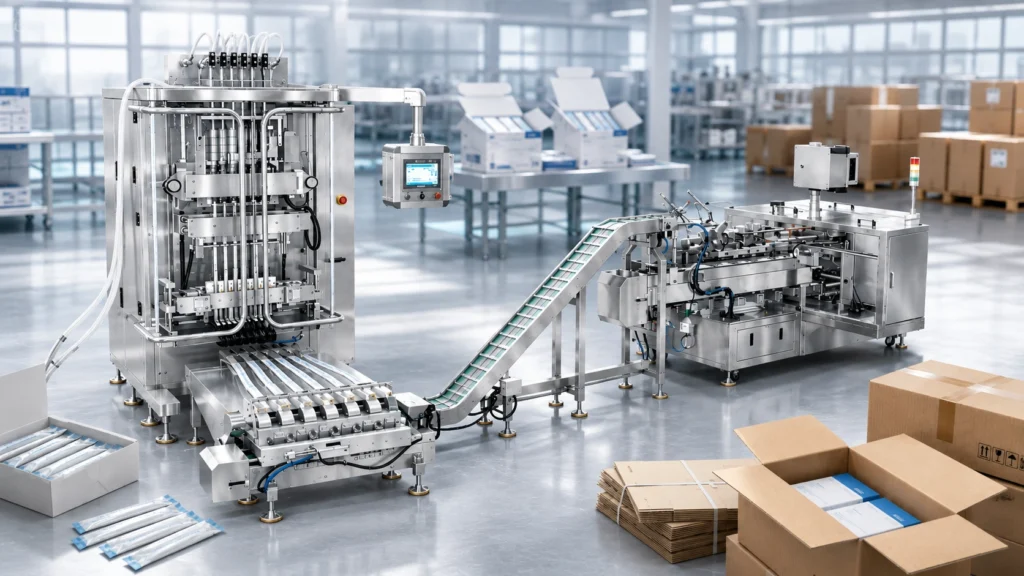
Require a Representative Sample Test
A supplier test should use production-representative material, not water or an unrelated substitute.
Record product temperature, fill volume, bag dimensions, film structure, machine speed, test duration, and settings.
Evaluate dose consistency, dripping, stringing, seal contamination, appearance, coding, cutting, leakage, and cross-lane consistency.
For a multilane system, one good lane is not sufficient evidence.
Changes to pump speed, nozzle height, cut-off timing, sealing temperature, or dwell time are normal during development.
Final accepted settings should be documented for commissioning and future production.
Common Buying Mistakes
The first mistake is selecting the highest lane count before confirming consistent distribution and dosing across every lane.
The second is accepting speed demonstrated with empty film. Empty-film speed does not prove stable filled-pack output.
Another mistake is approving only an empty bag drawing.
Buyers should approve filled samples because product volume, headspace, sealing margins, and handling can change the final result.
Do not treat the pump, bag, film, and sealing system as separate purchases.
They form one process. The best liquid food supplement stick pack packaging machines are configured and tested as a complete system around the actual product.
Select the Machine Around the Real Product
The best purchasing decision balances dosing stability, clean sealing, realistic output, cleaning access, changeover time, package quality, documentation, and future automation.
Start with the product sample and approved pack, then configure the pump, nozzle, bag-making system, sealing process, and speed around verified results.
Frequently Asked Questions (FAQ)
Compare machines by tested product compatibility, pump type, sealing performance, cleaning access, cross-lane consistency, actual output, package format, documentation, and future automation options. Do not compare equipment only by maximum speed or lane count.
There is no single best pump. Servo ceramic, piston, and peristaltic pumps suit different viscosities, dose ranges, particles, cleaning methods, and production targets. Select the pump through representative testing.
Potentially, but the products may require different pumps, nozzles, temperatures, forming sets, and speeds. Test both formulas and confirm the changeover procedure.
These are common target volumes, but the approved range depends on pump displacement, stick dimensions, film, product behavior, and machine configuration.
Keep product away from sealing margins, use compatible film, control sealing conditions, and coordinate filling with film movement. Finished packs still require seal and leakage testing.
No. The 240-stick-per-minute figure applies to EIXPACK’s tested eight-lane Mānuka honey project. Other formulas, doses, films, and stick sizes may run at different speeds.
Provide a representative product sample, viscosity and temperature information, particle details, target volume, stick dimensions, film, required output, coding needs, cleaning expectations, factory layout, and future automation plans.
Quick Quote Request
Send EIXPACK your product sample, target volume, stick size, film information, and required output.
The engineering team can evaluate the liquid’s filling behavior and recommend a liquid stick pack machine configuration for the tested application instead of relying on a generic specification.