
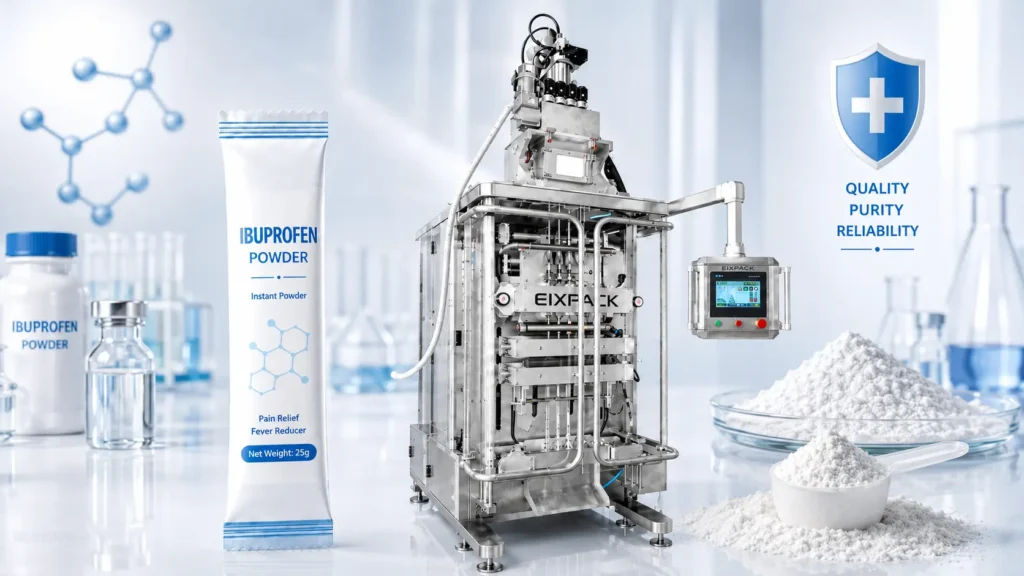
The best pharmaceutical stick pack packaging machines for contract manufacturers are not simply the fastest multilane systems. For U.S.-focused buyers, “best” means the line can handle pharmaceutical and nutraceutical applications without forcing the quality team to accept vague claims. A good machine should dose the real formulation consistently, keep powder or liquid away from the seal zone, support cleaning records, and change between client projects with predictable downtime.
Contract manufacturers face a different problem from single-brand manufacturers. A brand owner may buy one line for one product family. A CMO or CDMO may need to quote ibuprofen powder, paracetamol powder, aspirin powder, oral liquids, gels, granules, and supplement products on the same platform or within the same packaging department. That makes equipment flexibility valuable, but only if the flexibility is controlled through material testing, documentation, operator access, and changeover design.
Why stick packs work for pharmaceutical and nutraceutical applications
Stick packs are useful when a brand wants unit-dose convenience in a slim package. Compared with bottles, a stick pack can reduce measuring errors, simplify sampling, fit into cartons, and support lightweight shipping. For OTC powders, oral granules, liquid supplements, and gel products, the format can also improve consumer convenience because the user opens one dose at a time instead of measuring product from a bulk container.
For contract manufacturers, the business value is broader. A stick pack line can support short-run product launches, retail carton programs, sample kits, clinical-style batches, and recurring commercial production. The challenge is that each product behaves differently. Free-flowing granules may run smoothly, while cohesive analgesic powders can bridge in the hopper. A low-viscosity liquid may fill cleanly, while a gel may tail at the nozzle and contaminate the seal. This is why the first buying question should not be “How fast is the machine?” It should be “Which materials has this configuration been tested with, and under what conditions?”
Match the machine type to the material
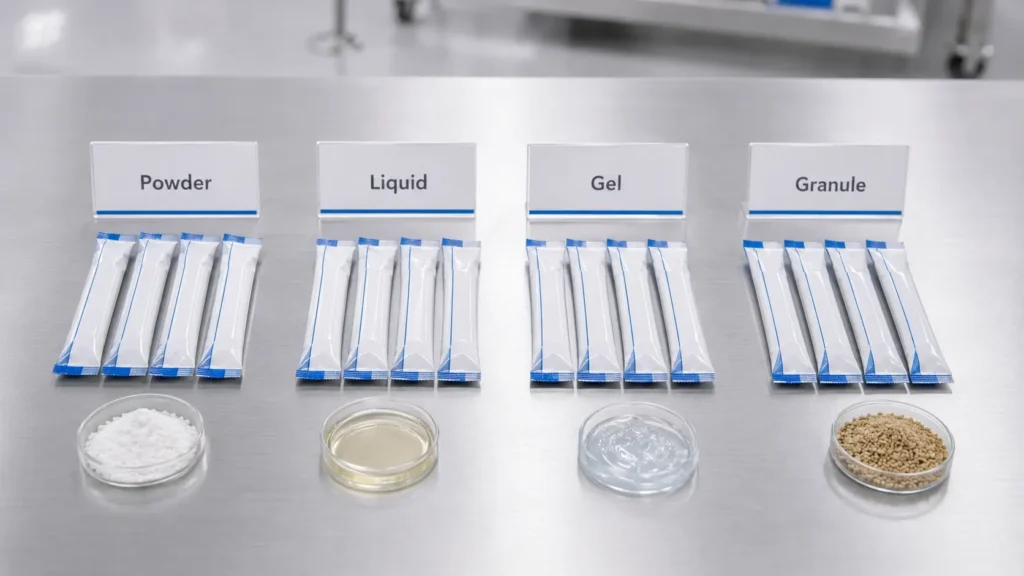
Powder products need a dosing system that matches flow behavior, bulk density, particle size, and dust level. Ibuprofen powder stick pack packaging machines, paracetamol powder stick pack packaging machines, and aspirin powder stick pack packaging machines should be tested with the real blend whenever possible. Excipients can change how a powder compacts, flows, or sticks to contact surfaces. For high-dust powders, a powder stick pack machine should be reviewed for dust extraction, static control, hopper agitation, seal-zone protection, and clean access around the forming area.
Liquid products require a different design logic. Pharmaceutical liquid stick pack packaging machines usually depend on pump selection, nozzle shut-off, tank design, and film handling. For ibuprofen liquid stick pack packaging machines, the buyer should first clarify whether the product is a true liquid, syrup, suspension, or liquid with particles that may settle. Suspensions may require tank agitation, short product paths, and filling methods that keep the active and inactive components uniformly distributed.
Gels sit between liquids and semi-solids. Pharmaceutical gel stick pack packaging machines need controlled cut-off, anti-drip nozzles, suitable product-contact parts, and sealing conditions that avoid product smear. If viscosity changes with temperature, heating, insulation, or controlled holding may be needed depending on the formula. A gel can look acceptable in a short test but create rejects during longer runs if residue slowly moves into the seal area.
Granules may appear easier, but they still need careful handling. Oral salts, coated particles, and effervescent granules can break if the filling action is too aggressive. The buyer should ask whether volumetric dosing, weighing, or another method is better for the dose size and particle fragility. A line that protects product structure can reduce giveaway and improve pack appearance.
Key systems contract manufacturers should evaluate
The dosing system should be reviewed before lane count. More lanes can increase output, but a fast line with unstable dosing creates expensive reject investigations. For powders, compare auger, cup, and weighing approaches based on the product. For liquids and gels, review pump type, nozzle cut-off, mixing, heating or holding, and cleaning access. EIXPACK product input indicates that pump type can be selected according to material behavior, which is the right approach for mixed liquid and gel projects.
Cleaning and changeover design should be treated as a profit factor, not just a hygiene feature. A CMO rarely runs one SKU forever. Quick-release hoppers, removable contact parts, manual cleaning access, and CIP/SIP where applicable can reduce idle time between products. EIXPACK product input notes fast contact-part disassembly of about 15 minutes on suitable configurations, which is useful for multi-SKU production, but each customer should confirm the exact machine layout and cleaning procedure before using that figure in a validation plan.
Seal quality is another priority. Stick packs have long, narrow seals, and small film tracking errors can affect many packs across several lanes. Buyers should review jaw alignment, sealing temperature stability, pressure distribution, film tension, notch quality, cutting accuracy, leak testing, and how the machine prevents product from entering the seal zone. Powder dust, liquid droplets, and gel tails all create different sealing risks. Packaging film and barrier selection should also be reviewed alongside the FDA guidance on container closure systems, especially when the final product will be marketed as a regulated drug in the United States.
Inspection and coding should be planned early. A pharmaceutical or nutraceutical stick pack project may need lot coding, expiration-date printing, print verification, missing-pack detection, checkweighing, reject confirmation, and downstream cartoning. Even if the first project is simple, the machine layout should leave room for later inspection modules. Retrofitting after customer approval or internal qualification can be more disruptive than planning interfaces from the start.
A practical buying workflow for CMOs and CDMOs
Start with the product pipeline, not the machine brochure. List the products expected over the next two to three years and group them as powders, liquids, gels, and granules. Then identify the hardest product in each group: the dustiest powder, the most cohesive blend, the most viscous gel, the most foam-prone liquid, or the most fragile granule. The machine should be tested against difficult materials, not only easy demonstration samples.
Next, define the business model. A pilot or small-batch line needs fast setup, low film waste, and easy cleaning. A commercial OTC line needs higher output, automated feeding, stronger inspection, and possible cartoning integration. A CMO serving many clients may make more profit from short changeovers than from maximum theoretical speed. A dedicated line for one major customer may prioritize continuous operation, spare-part planning, and data reporting.
Then run material trials using real product and real packaging film wherever possible. Ask for samples from every lane. Review fill weight, seal appearance, edge quality, tear notch usability, code position, pack feel, and leakage after handling. For powders, inspect the seal area for dust. For liquids and gels, inspect the jaws and film path for residue. If the formulation cannot be shared before purchase, at least provide a close technical brief so the supplier does not design around the wrong assumptions.
Common mistakes that delay projects
The first mistake is buying lane count before understanding changeover demand. A twelve-lane line may look attractive on paper, but each lane adds tooling, film tracking points, cleaning surfaces, and reject investigation work. A stable six- or eight-lane line may outperform a larger line if the project mix requires frequent product changes.
The second mistake is using substitute materials for testing. Water does not behave like syrup, starch does not behave like an analgesic blend, and a short gel test does not reveal long-run nozzle tailing. Contract manufacturers should test with real or technically equivalent materials before finalizing the dosing and sealing configuration.
The third mistake is ignoring secondary packaging. Stick packs usually need counting, grouping, cartoning, leaflet handling, checkweighing, or case packing. A primary machine can be fast while the discharge area becomes the bottleneck. Layout should include conveyors, reject bins, access doors, operator movement, and space for future automation.
Final selection advice
For contract manufacturers, the best pharmaceutical stick pack packaging machines are the ones that protect product quality while keeping the business flexible. They should run the target material cleanly, hold the dose consistently, seal reliably, support cleaning, allow practical changeover, and leave room for inspection and secondary packaging. Speed matters, but only after the product, package, operator, and quality requirements are understood.
Before sending an RFQ, prepare four pieces of information: the formulation type, target fill range, packaging film requirement, and expected production model. Then ask the supplier to explain the dosing system, cleaning path, changeover steps, testing plan, and documentation support. That conversation will reveal much more than a catalog specification.
Product Type |
Suitable Machine Focus |
Key Buying Questions |
Typical Risk |
|---|---|---|---|
Ibuprofen / paracetamol / aspirin powders | Powder stick pack machine with dosing options and dust control | Can the real blend run without dust entering the seal area? | Dust, bridging, weight variation |
Pharmaceutical and nutraceutical liquids | Liquid stick pack machine with material-specific pump selection | Is it a true liquid, syrup, suspension, or foam-prone liquid? | Splashing, foaming, settling |
Pharmaceutical gels | Gel stick pack machine with anti-drip nozzle and controlled cut-off | Does viscosity change with temperature or holding time? | Nozzle tailing, seal smear |
Granules / oral salts | Granule stick pack machine with gentle filling | Are particles fragile, coated, or effervescent? | Particle breakage, dose giveaway |
Multi-client CMO projects | Configurable multilane stick pack platform | How fast can the line clean, change over, and document the process? | Validation delays, downtime |
Frequently Asked Questions (FAQ)
They are used to form, fill, seal, code, and cut narrow unit-dose packs for powders, liquids, gels, and granules. For EIXPACK content, “pharmaceutical and nutraceutical applications” is a safer and more accurate positioning unless a specific regulated drug project has been confirmed.
The machine platform may be similar, but the real blend should be tested. Particle size, excipients, dust level, and bulk density can affect dosing, flow, and seal cleanliness.
Buyers should confirm whether the formula is a true liquid, syrup, suspension, or foam-prone product. Pump type, nozzle shut-off, tank agitation, heating, holding, and cleaning access should be reviewed before purchase.
Some platforms can be configured for different materials, but dosing systems, product-contact parts, and cleaning procedures usually change. A contract manufacturer should confirm changeover time and validation impact before assuming one line can handle all products.
Gels may tail at the nozzle, smear onto the film, or contaminate the seal area. Anti-drip nozzles and controlled cut-off help reduce reject risk.
EIXPACK can support U.S.-market projects with sample testing, configuration discussion, installation support, after-sales service, remote commissioning, spare parts, and technical layout communication. Final regulatory suitability should still be confirmed by the buyer’s quality team.