
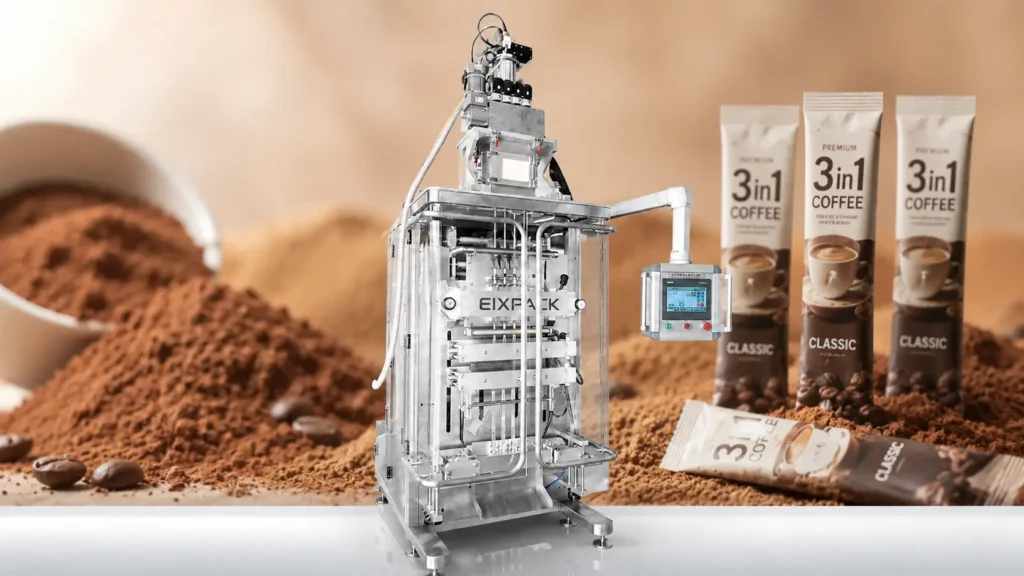
For U.S. coffee factories and contract manufacturers, 3-in-1 instant coffee mix stick pack packaging machines must do more than form a narrow single-serve sachet. They need to dose blended coffee powder consistently, manage sugar and creamer dust, protect seal quality, support 15–60 g fill weights, and connect with downstream counting, coding, inspection, and cartoning when retail multipacks are required.
A 3-in-1 instant coffee mix usually combines instant coffee, sugar, and creamer or whitener. Some formulas may include soluble coffee granules, cocoa powder, cappuccino foam ingredients, flavor powder, or non-dairy creamer. These ingredients often have different particle sizes, densities, and flow behaviors. That is why a coffee stick pack machine should be selected around the real formula, not only the target stick size.
For buyers still comparing different stick pack formats, EIXPACK’s stick pack machine solutions provide a useful starting point for reviewing powder, liquid, gel, and granular packaging directions.
Why 3-in-1 Coffee Mix Needs Specialized Stick Pack Equipment
Compared with plain instant coffee powder, 3-in-1 coffee mix creates more packaging risk. Sugar granules can settle in the hopper. Creamer powder can be light, dusty, and difficult to keep away from the seal area. Coffee particles may absorb moisture or lose aroma if the package has poor barrier performance. If the machine does not control feeding, dosing, and sealing as one system, finished sticks may vary in taste, weight, and appearance.
The most common filling direction for coffee stick pack packaging machines is auger dosing. A servo auger can meter powder by screw rotation and is often suitable for coffee powder, creamer blends, and similar dry mixes. However, soluble granular coffee stick pack packaging machines may need adjusted screw geometry, hopper agitation, or vibration control to reduce particle damage and prevent segregation.
How Coffee Stick Pack Packaging Machines Work
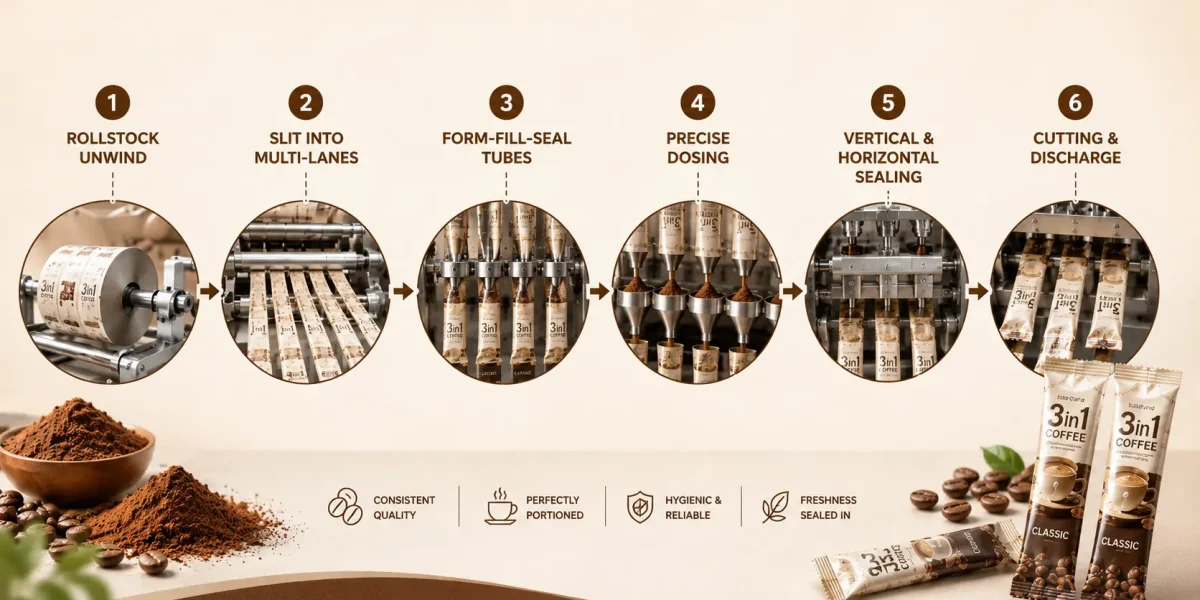
Most coffee stick pack packaging machines use vertical form-fill-seal technology. Rollstock film is unwound, slit into lanes, shaped around forming tubes, sealed lengthwise, filled through a dosing system, sealed horizontally, cut, and discharged. A multi-lane machine repeats this process across several lanes to increase output while keeping each stick narrow and consistent.
For a 6-lane coffee stick pack machine, all lanes must remain balanced. If one lane has poor film tracking, seal contamination, or dosing drift, the whole line may slow down. Buyers should ask how the machine monitors lane performance, how operators adjust bag length and temperature, and how quickly the machine can be cleaned between coffee flavors or formulas.
What 15–60 g Fill Weight Means for Machine Selection
A 15–60 g fill range is broader than many small-dose stick pack projects. A 15 g coffee stick may be designed for a compact single cup serving, while a 60 g stick may need a longer pack, stronger film control, and enough volume for a sugar-creamer-coffee blend. The machine must handle the full operating range without forcing the buyer into unstable dosing or oversized packaging.
For EIXPACK coffee powder projects, the supplied configuration reference is 6 lanes with output up to 180 sticks/min and dosing accuracy of ±1%, based on brand-provided information. This is a useful reference for U.S. factories comparing mid-to-high-volume coffee stick production, but the final performance should always be confirmed with the actual product, final film, target weight, and test conditions.
Matching the Machine to 2-in-1, 3-in-1, Cappuccino, and Granular Coffee
2-in-1 instant coffee mix stick pack packaging machines are usually used for coffee plus sugar or coffee plus creamer. These products may be simpler than 3-in-1 blends, but they still require moisture protection, clean sealing, and stable mixing behavior. If sugar granules and coffee particles separate during feeding, the finished pack may not match the intended taste.
3-in-1 instant coffee mix stick pack packaging machines should be evaluated for flow control, dust management, and seal protection. The biggest issue is not only weight accuracy. It is whether each stick receives a uniform blend of coffee, creamer, and sugar while the seal area remains clean enough to maintain package integrity.
Cappuccino stick pack packaging machines may need extra attention because cappuccino powders can contain foaming ingredients and low-density powders. These products may require more pack volume, careful hopper design, and stable sealing temperature. Soluble granular coffee stick pack packaging machines should also be checked for granule breakage and repeatable dosing.
Film, Sealing, and Food-Contact Considerations
Coffee packaging depends heavily on film performance. Instant coffee mix is sensitive to moisture, oxygen, aroma loss, and clumping. Common laminate directions may include high-barrier structures such as PET/AL/PE or PET/VMPET/PE, but the final film structure must be confirmed by the buyer, packaging material supplier, and quality team.
For the U.S. market, food-contact suitability should not be assumed. Packaging films, inks, adhesives, and product-contact machine parts should be reviewed for intended use. A machine supplier can advise on film handling and sealing behavior, but the brand or manufacturer remains responsible for confirming final regulatory suitability with qualified advisors. Recommended external reference: FDA food contact substances guidance.
Automation Options for U.S. Contract Manufacturers
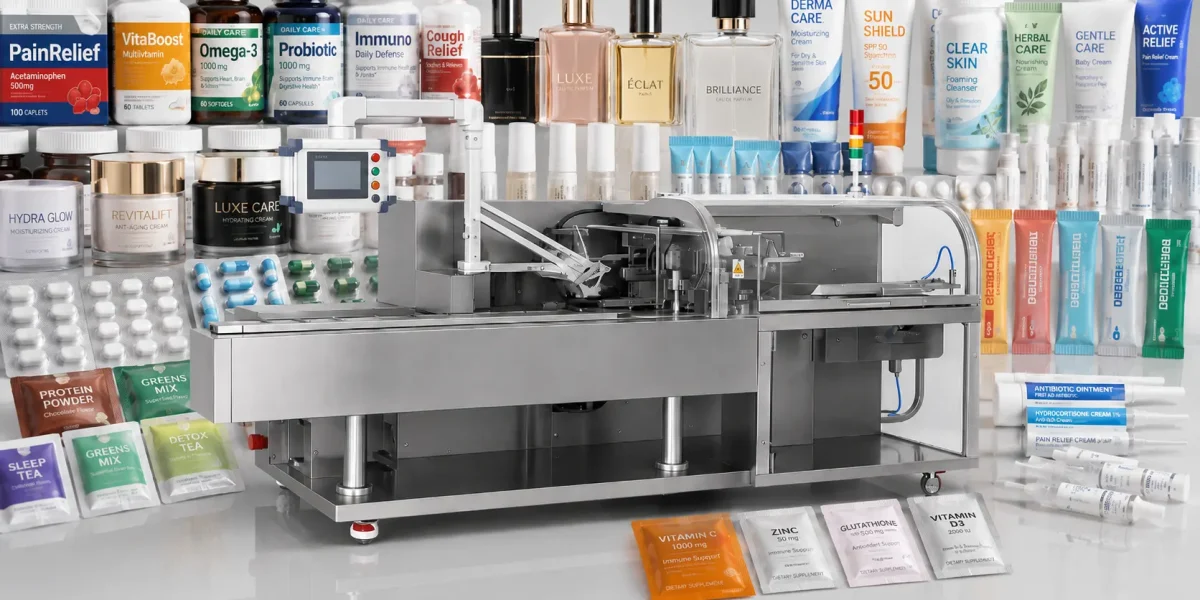
Contract manufacturers often need more than a primary coffee stick pack machine. A practical line may include automatic counting, date coding, checkweighing, metal detection, rejection, grouping, and cartoning. These modules help reduce manual handling, improve batch control, and make finished coffee sticks easier to prepare for retail cartons, club-store packs, or private-label orders.
EIXPACK supports integration with automatic counting, cartoning, checkweighing, metal detection, and coding systems based on the project information provided. If a coffee factory plans to pack finished sticks into cartons, the cartoning machine should be discussed early. Stick discharge, counting accuracy, carton size, leaflet needs, and reject handling should be designed as part of one workflow.
Because stick pack lines include moving parts, heated sealing jaws, cutting systems, and access doors, U.S. factories should review guarding, interlocks, and safe access against the OSHA machine guarding requirements.
Common Buying Mistakes
The first mistake is buying only by speed. A 6-lane machine may be capable of strong output, but real performance depends on product flow, fill weight, film quality, operator skill, cleaning time, and downstream capacity. If cartoning cannot keep up with the stick pack machine, the production bottleneck simply moves to the end of the line.
The second mistake is testing with the wrong material. Generic powder cannot fully represent 3-in-1 coffee mix. Buyers should send the real formula, including sugar, creamer, soluble coffee, and flavor ingredients. If the project includes several SKUs, test the most difficult formula, not only the easiest one.
The third mistake is ignoring package quality from the consumer’s perspective. A stick pack should tear cleanly, pour easily, and look consistent in a carton. Poor cuts, dusty surfaces, weak seals, or hard-to-open sticks can damage the retail experience even when the machine reaches the target speed.
Final Buying Advice
The best 3-in-1 instant coffee mix stick pack packaging machines are not selected by catalog speed alone. They are selected by how well they handle the real coffee formula, 15–60 g fill range, dust control, sealing stability, film compatibility, inspection needs, and downstream automation. For U.S. coffee factories and contract manufacturers, the safest decision is to test the actual product and film before confirming the final configuration.
If you are comparing 2-in-1, 3-in-1, cappuccino, or soluble granular coffee stick pack packaging machines, EIXPACK can review your product specifications and help discuss a suitable powder stick pack, stick pack, and cartoning configuration. Share your formula, target grams per stick, film plan, output goal, and automation requirements to start a practical equipment conversation.
Coffee Product Type |
Recommended Machine Direction |
Main Packaging Risk |
EIXPACK-Relevant Configuration Point |
|---|---|---|---|
2-in-1 instant coffee mix | Powder stick pack machine with auger dosing | Sugar separation, moisture sensitivity, inconsistent blend | Test formula stability and dosing repeatability |
3-in-1 instant coffee mix | 6-lane coffee stick pack machine for 15–60 g packs | 6 lanes / 180 sticks/min / ±1% based on supplied EIXPACK data | Creamer dust, seal contamination, blend segregation |
Cappuccino mix | Cappuccino stick pack packaging machine with suitable hopper control | Low-density powder, foaming ingredient flow, larger pack volume | Confirm hopper design and finished stick appearance |
Soluble granular coffee | Soluble granular coffee stick pack packaging machines or adjusted auger system | Granule breakage, inconsistent flow, dosing variation | Test particle size, screw profile, and vibration control |
Retail coffee stick cartons | Stick pack machine plus cartoning machine | Counting errors, carton jams, damaged sticks | Integrate counting, coding, inspection, and cartoning early |
Frequently Asked Questions (FAQ)
They are used to form, fill, seal, cut, and discharge single-serve stick packs for instant coffee blends containing coffee, sugar, creamer, and sometimes flavor or foaming ingredients.
EIXPACK can support 15–60 g coffee powder stick pack projects. Final performance should be confirmed with real product and film testing.
The supplied reference configuration is 6 lanes with up to 180 sticks/min for coffee powder applications, subject to product, fill weight, film, and test conditions.
The supplied EIXPACK project data states ±1% dosing accuracy. Buyers should verify accuracy using their real coffee mix, especially when sugar, creamer, and coffee particles differ in density.
It may be possible with the right configuration, but each formula should be tested. Different powders and granules may require different auger settings, hopper design, vibration control, and cleaning procedures.
For small batches, manual packing may be enough. For retail cartons, multipacks, or contract manufacturing, automatic counting, cartoning, coding, checkweighing, and metal detection can reduce labor and improve consistency.
CTA
Planning a 2-in-1, 3-in-1, cappuccino, or soluble granular coffee stick pack project? Share your formula type, target fill weight, stick size, film plan, output goal, and automation needs with EIXPACK to discuss a practical machine configuration for your coffee factory or contract manufacturing line.