
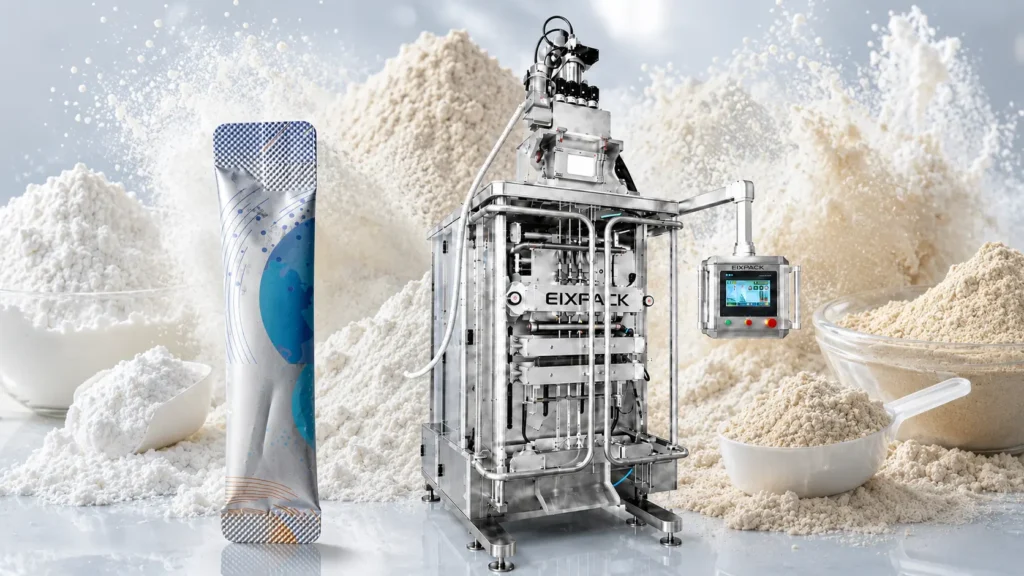
Food supplement powder stick pack packaging machines are a practical choice when nutraceutical brands, pharmaceutical companies, contract manufacturers, and food brands need single-serve powder packaging with controlled dose weight, compact presentation, and convenient consumer use. The right machine, however, is not chosen by speed alone. A reliable decision starts with powder behavior, target fill weight, film structure, dust control, cleanability, traceability, and the production volume you expect to reach after scale-up.
Stick packs are widely used for vitamin powder, collagen powder, protein powder, electrolyte blends, probiotics, powdered drink mixes, and some OTC or pharmaceutical powders. They reduce the need for scoops, improve portion control, and make sampling easier. For buyers, the challenge is that fine powders can create dust, static, bridging, and seal contamination. A good stick pack machine must manage these risks while maintaining dosing consistency and pack appearance.
Start with the powder formula
Before comparing any machine, define the powder in technical terms. Important details include bulk density, particle size, flowability, moisture sensitivity, dust level, target grams per stick, acceptable dose tolerance, and whether the product contains active ingredients. A vitamin powder stick pack packaging machine for a free-flowing drink mix may not run the same way when used for collagen, protein powder, or a mineral-heavy blend. Testing the actual formula is always more useful than testing only one ingredient.
For paracetamol powder stick pack packaging machines or other pharmaceutical-related powder projects, the machine decision should also consider documentation, batch coding, traceability, cleaning procedures, and quality review. The forming, dosing, sealing, and cutting principles may look similar to supplement packaging, but the quality expectations can be stricter.
Choose multi-lane capacity carefully
Multi-lane equipment is attractive because it can raise output without using multiple separate machines. EIXPACK’s public powder stick pack machine page lists a multi-lane powder packaging machine, up to 400 bags per minute, and ±0.1g dosing precision for powder applications. These published values are useful for early comparison, but final speed and accuracy should be confirmed with the actual powder, target fill weight, film, lane count, and quotation documents.
More lanes are not always better. A contract manufacturer running many SKUs may value fast changeover and recipe control more than maximum output. A supplement brand with one flagship formula may prioritize continuous high-volume production. A pharmaceutical company may need more emphasis on repeatability, batch records, coding, rejection logic, and cleaning validation support. Choose the number of lanes based on real orders, not only future ambition.
Match the dosing system to the powder
For nutraceutical powders stick pack packaging machines, servo auger dosing is often the most practical option for fine powders. The auger can meter powder into narrow stick packs with controlled rotation, and independent control can help maintain lane-to-lane consistency. Important details include auger diameter, hopper agitation, anti-bridging design, product contact material, fill nozzle design, and whether the system can support sampling or checkweigher feedback.
Powder blends can separate during vibration, especially when ingredients have different densities or particle sizes. If the formula includes sweeteners, minerals, fibers, flavors, or active ingredients, the feeding system must keep the blend uniform before filling. For high-value formulas, small overfills can increase cost across long production runs, while underfills create quality and compliance risk.
Control dust, static, and seal contamination
Powder on the sealing area is one of the most common causes of weak seals and rejected stick packs. Fine powders can cling to film, float into the seal zone, or contaminate the sealing jaws. For this reason, buyers should evaluate dust extraction, static elimination, controlled filling nozzles, enclosed seal protection, and easy access for cleaning. EIXPACK’s powder page mentions customized dust collectors and static eliminators for fine powders, which are relevant features to discuss during technical evaluation.
Avoid absolute promises such as “zero dust” or “100% leak-proof” in your internal specification. A better specification is measurable: acceptable reject rate, seal strength target, dust collection method, inspection logic, cleaning access, and test conditions. Ask the supplier to run your powder and show sample packs before final approval.
Select film and stick pack format
Stick pack film must protect the powder from moisture, oxygen, light, odor transfer, and handling damage. Depending on the product, a film supplier may recommend PET, aluminum foil laminate, PE, paper-based laminate, or other barrier structures. Hygroscopic powders such as electrolyte blends and some vitamin formulas often need stronger moisture protection than simple dry drink mixes.
The pack format also affects consumer experience. Straight cut, easy-tear notch, rounded corners, shaped sticks, or connected stick strips can support different retail and sampling strategies. EIXPACK’s public pages show multiple stick pack style options and note that pouch length can be adjusted through the touchscreen, while different bag widths require customized forming tubes. This is useful for brands planning multiple SKUs or future packaging refreshes.
Plan for U.S. compliance and traceability
For the United States, supplement and pharmaceutical-related buyers should treat packaging equipment as part of a controlled production system. The FDA’s CGMP resources for food and dietary supplements and 21 CFR Part 111 are useful references for understanding why equipment suitability, cleaning, records, packaging controls, and quality procedures matter. The packaging machine itself does not make a product compliant; compliance depends on the full process, facility, documentation, operators, and quality system.
For U.S.-oriented projects, ask whether the supplier can support SOP documentation, IQ/OQ/PQ cooperation, batch printing, traceability records, cleaning validation support, detection and rejection logic, and FAT documentation. Use that discussion to define the documentation package before placing an order.
Powder safety should also be reviewed. OSHA notes that combustible material in fine particle form can become explosible under certain conditions. Not every supplement powder has the same risk, but facilities handling botanical powders, starches, sweeteners, fibers, or other dust-generating materials should review dust collection, grounding, ventilation, housekeeping, and local safety rules with qualified professionals.
Compare suppliers using test evidence
A serious supplier should ask for material samples, target fill weight, pack dimensions, film structure, target speed, cleaning expectations, and downstream packaging plans. The best conversations are technical, not only commercial. Ask how the machine handles start-up waste, stop-start dosing, film tracking, cutting, rejected packs, coding, dust control, and operator access.
Selection table: what to prioritize
Project type |
Main risk |
What to prioritize |
Supplier question |
|---|---|---|---|
Startup supplement brand | Buying too much capacity too early | Flexible format, custom pack size, easy cleaning | Can the machine support my current pack and a future SKU? |
Contract manufacturer | Frequent changeovers | Multi-lane flexibility, recipe control, fast cleaning | How long does changeover take with real powder and film? |
Vitamin powder brand | Moisture and dose consistency | Moisture and dose consistency | Can you test my vitamin blend with my chosen laminate? |
Protein or collagen powder | Poor flow and dust | Hopper agitation, dust collection, static control | How is powder kept away from the sealing area? |
Pharmaceutical or OTC powder | Documentation and traceability | Batch coding, rejection logic, FAT, IQ/OQ/PQ support | What documents can you provide for QA review? |
Frequently Asked Questions (FAQ)
The best stick pack machine depends on powder flow, target fill weight, film barrier, lane count, cleaning needs, and compliance expectations. For fine powders, servo auger dosing, dust extraction, static control, and seal protection are usually important.
It may be possible if the machine is configured correctly, but both formulas should be tested. A vitamin powder stick pack packaging machine may need different auger settings, hopper agitation, and sealing parameters when switching to protein powder.
The mechanical principles can be similar, but pharmaceutical or OTC projects usually require stricter documentation, batch traceability, cleaning procedures, rejection logic, and QA review. Confirm the regulatory and quality expectations before selecting equipment.
Focus on controlled filling, dust extraction, static elimination, stable film tracking, correct sealing temperature, and a clean seal zone. Leakage should be solved as a full system issue, not only as a sealing-jaw issue.
Send your powder sample, target fill weight, pack width and length, preferred film structure, expected speed, number of SKUs, cleaning needs, coding requirements, and any U.S. documentation needs such as SOP, IQ/OQ/PQ, traceability, or FAT support.
Quick Quote Request
Choosing food supplement powder stick pack packaging machines becomes easier when you send real material data instead of only asking for a price. Review EIXPACK’s powder stick pack machine page, compare the multi-lane stick pack machine category, and request a custom quote with your powder sample, packaging size, output goal, and compliance requirements.