
Choosing an ibuprofen stick pack machine supplier should begin with the finished formulation and measurable acceptance criteria—not the highest speed in a brochure.
For a 0.2 g finished powder blend, the supplier must prove that dosing, powder feeding, dust control, film handling, sealing, cleaning, controls, and downstream automation work together under realistic production conditions.
The supplier must also distinguish machine capability from the customer’s responsibility for drug approval, process validation, labeling, and product release.
A suitable supplier should demonstrate its capabilities through an actual ibuprofen powder packaging solution, representative sample testing, documented Factory Acceptance Testing and clearly defined project responsibilities.
Define the Product Before Comparing Machines
The first specification should state that 0.2 g is the total weight of the finished blended powder in each stick pack, not the weight of ibuprofen API alone.
This affects auger size, screw pitch, dosing rotation, outlet dimensions, hopper design, and the weighing method. The words “ibuprofen powder” alone are not enough to select a dosing configuration.
Provide representative production material whenever possible.
The supplier should evaluate bulk density, particle size, flowability, oil content, moisture sensitivity, dust generation, electrostatic behavior, and the tendency to bridge or adhere to product-contact surfaces.
Excipients can change powder behavior, so performance with another pharmaceutical or supplement powder is not proof for the final blend.
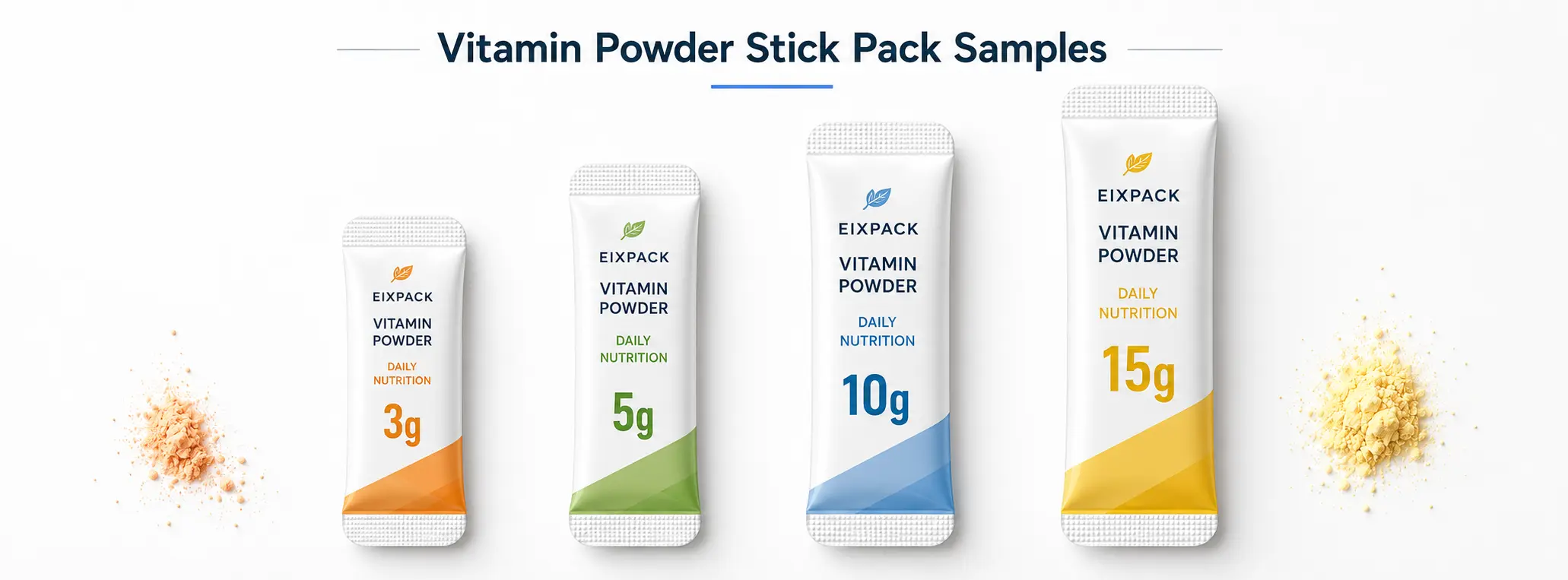
Confirm the bag width, length, easy-tear design, coding area, seal width, film-roll specification, and secondary packaging format before the final quotation.
These details influence forming parts, film tension, sealing time, cutting, and discharge.
Verify 0.2 g Dosing With Lane-by-Lane Data
The confirmed filling accuracy is ±0.5%. At a 0.2 g target, this equals ±0.001 g, or ±1 mg. The supplier should show how the result was measured across all ten lanes. A single average is insufficient because it can hide one lane that consistently fills high or low.
Request the target, mean, minimum, maximum, standard deviation, sample quantity, test speed, reject quantity, scale resolution, and individual-lane results. The weighing instrument must be suitable for a 1 mg tolerance, and the FAT protocol should define sampling frequency and corrective action.
Test dosing through hopper refills, normal stops, restart, and continuous operation. Small fills are sensitive to changes in powder head pressure, density, and screw loading. Stable performance requires both servo control and a formulation-specific auger.
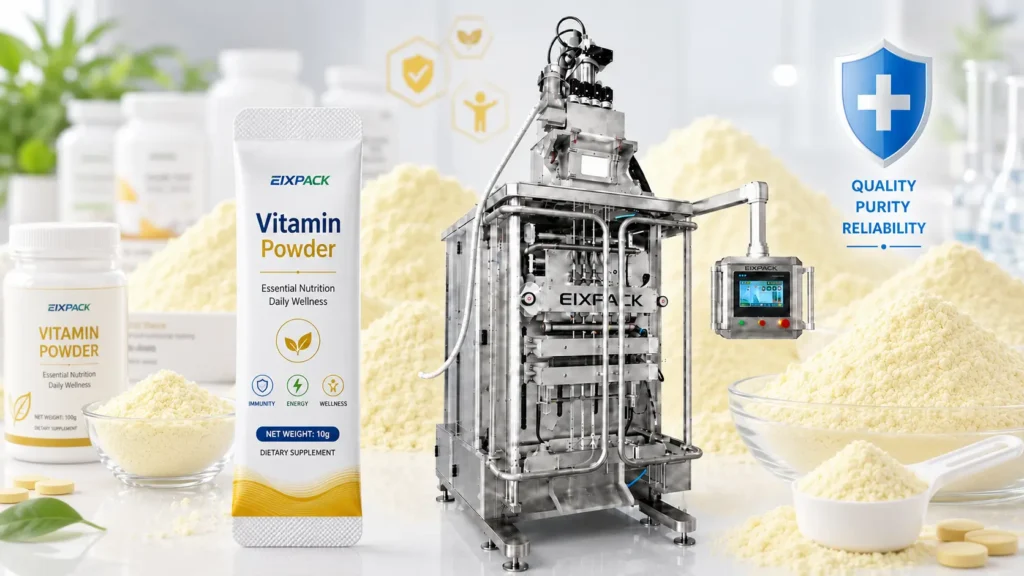
The EIXPACK powder stick pack machine platform can be configured for multi-lane powder filling. General specifications such as ten lanes, up to 400 bags per minute and ±0.1 g platform accuracy should be treated as product-platform references. For this 0.2 g application, the project-specific acceptance target is ±0.5%, based on testing with the finished blend.
Evaluate Feeding, Dust Control, and Static Elimination
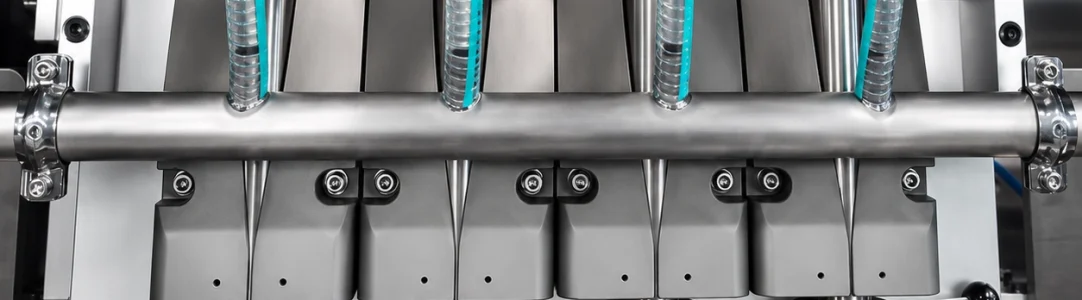
An oily, moisture-sensitive powder may adhere to hopper walls or form deposits around the outlet.
Vacuum feeding can reduce manual handling and stabilize hopper level, but transfer velocity, filter design, refill sequence, and conveying distance must match the blend.
Dust extraction should capture airborne powder near dosing and forming without removing product from the measured dose or disturbing the film.
Ask the supplier to identify extraction points, airflow, filter access, cleaning method, and the interface with the plant’s dust-collection system. Static elimination can reduce powder attraction to the laminate and forming parts.
The plant’s EHS team should review the product safety data and exposure risks.
The OSHA chemical-hazards guidance explains that workplace chemicals may create health and physical hazards and that employers must identify and evaluate respiratory hazards.
The machine supplier can provide extraction interfaces and guards, but the final containment strategy depends on the site assessment.
Match the Pharmaceutical Laminate and Seal Window
A suitable high-barrier direction may combine an outer PET or paper layer, an aluminum-foil barrier, and an inner PE or PP heat-seal layer.
The final structure, thickness, barrier performance, print system, and sealant should be confirmed with the film supplier and supported by stability work.
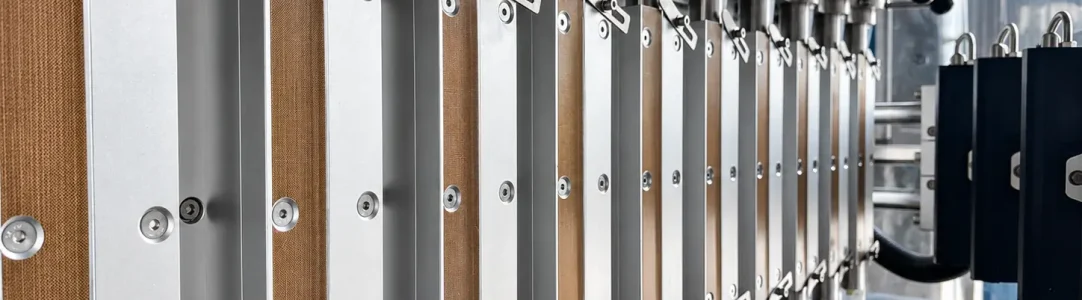
The trial should use the intended production film. Test tracking, slitting, registration, forming, longitudinal and cross sealing, coding, cutting, easy-tear performance, and appearance.
The correct setting is not one temperature value; it is a stable window balancing temperature, pressure, dwell time, speed, and film characteristics.
Powder contamination is a key seal risk. Dosing timing, powder-settling time, extraction position, and sealing-jaw movement should reduce powder trapped between film layers.
Inspection should cover wrinkles, channels, trapped powder, delamination, weak seals, and visible defects.
Interpret the 99.95% Seal Result Correctly
The confirmed test produced 192,000 stick packs during an eight-hour continuous run at 400 sticks per minute.
The recorded sealing pass rate was 99.95%, mathematically equivalent to approximately 191,904 accepted packs and 96 packs outside the defined sealing criteria.
This result supports stable performance under the tested formulation, film, settings, speed, and environment.
It is not an unconditional guarantee for every powder, laminate, bag size, or factory. Changes in moisture, sealant layer, speed, or product buildup may require new optimization.
Attach the sealing method to the FAT record. It should identify the laminate, sampling plan, inspection frequency, leak or peel method, acceptance threshold, and treatment of packs produced during start-up, splicing, stops, and restarts.
Transparent evidence is more useful than an unsupported percentage.
Make Cleanability and Documentation Purchase Criteria
Buyers should examine how the hopper, auger, outlet, forming parts, chutes, and dust-control components are removed, cleaned, inspected, dried, protected, and reassembled.
Product-contact areas should be accessible, with minimal locations where powder can accumulate.
21 CFR Part 211 requires drug-manufacturing and packing equipment to be appropriately designed and located for its intended use, cleaning, and maintenance.
It also requires written procedures covering equipment cleaning, disassembly, reassembly, protection before use, inspection and associated records.
Request a live changeover demonstration. For a contract manufacturer, measure from the final acceptable pack of one SKU to the first acceptable pack of the next, including line clearance, cleaning, verification, recipe loading, and start-up checks—not mechanical disassembly alone.
The quotation should define material certificates, contact-part lists, manuals, electrical and pneumatic drawings, calibration points, cleaning instructions, preventive-maintenance schedules, spare-parts lists, and the supplier’s IQ/OQ support scope.
Check Controls, Inspection, and Cartoning Integration
A pharmaceutical line may require batch and expiration coding, print inspection, mark registration, missing-code rejection, checkweighing, metal detection, counting, and cartoning.
A complete interface list should define start, stop, alarm, reject, accumulation, and emergency-stop logic.
Review user levels, recipe permissions, parameter-change records, alarm history, backups, and data export.
A touchscreen and PLC do not automatically provide audit trails or electronic-record compliance. Required functions must be written into the user requirement specification.
The line layout should show operator access, powder and film flow, rejected-pack handling, maintenance space, and utilities.
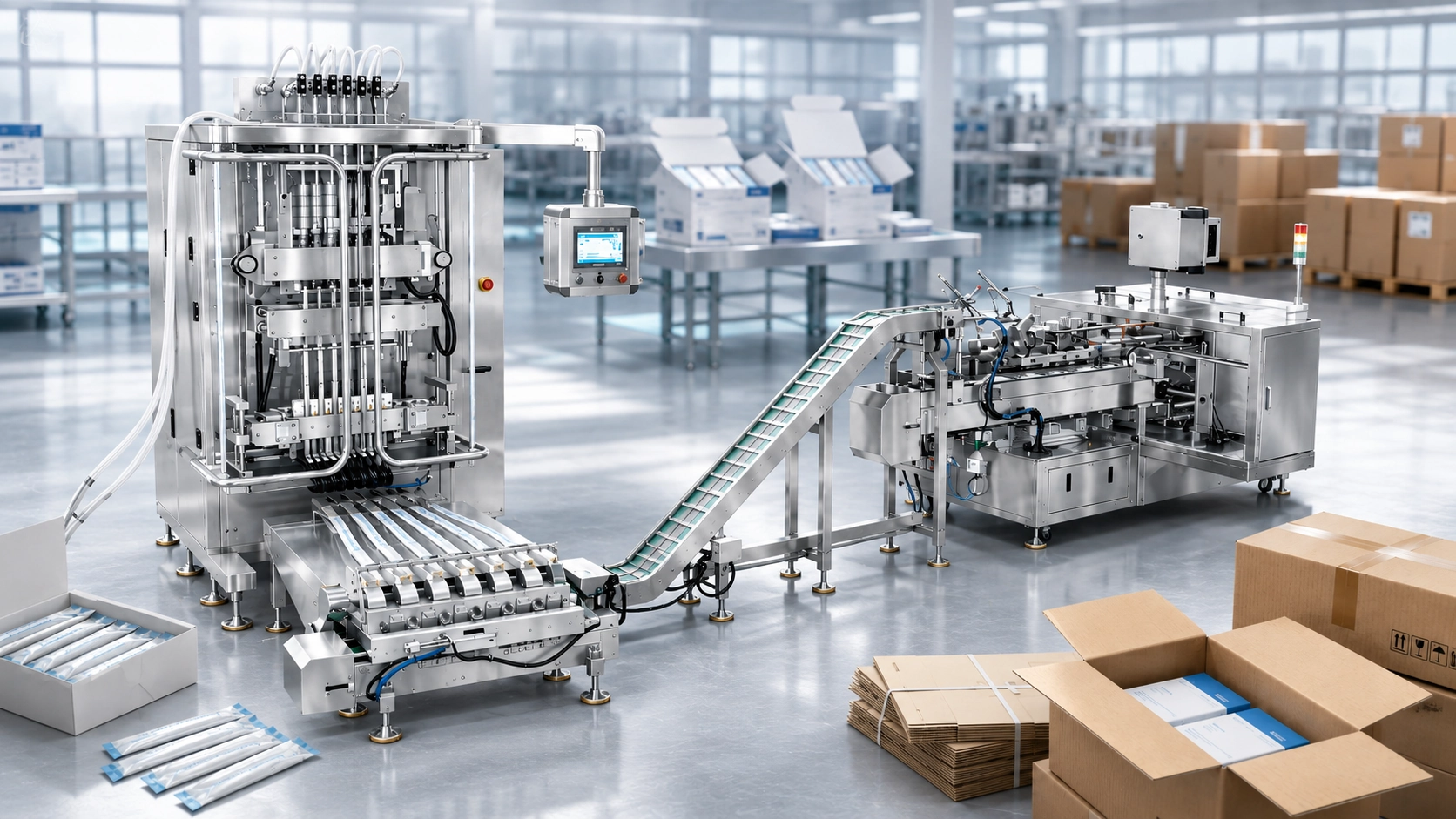
Confirm that downstream equipment can handle the peak discharge from the ten-lane packer; otherwise, the bottleneck simply moves to inspection or cartoning.
Confirm the U.S. Regulatory Pathway
Ibuprofen appears in OTC products in the United States, but not every ibuprofen powder stick pack automatically qualifies as an OTC drug. FDA states that nonprescription drugs enter the U.S. market through either the drug-application pathway or the FDA OTC drug monograph process.
An OTC monograph establishes conditions including active ingredients, indications, doses, routes of administration, labeling, and testing.
OTC Monograph M013 covers specified internal analgesic, antipyretic, and antirheumatic drug products.
It does not prove that an unreviewed stick-pack formulation, dose, dosage form, claim, or direction is automatically permitted. The finished product’s status must be confirmed by the brand owner’s or manufacturer’s regulatory and quality teams.
Where Drug Facts labeling applies, the package must provide the required content and legibility.
This can affect stick dimensions, outer-carton design, coding space, and secondary packaging.
The machine supplier supports dosing, sealing, coding, inspection, and cartoning; it does not approve the finished drug product.
Use Sample Testing and FAT to Choose the Supplier
Send shortlisted suppliers the same representative powder, film, bag specification, dose tolerance, seal criteria, coding content, and required speed. The test should include start-up, steady running, hopper refill, planned stop, restart, and enough duration to reveal heat buildup, powder accumulation, tracking drift, or lane variation.
The FAT should document output, lane weights, seal results, coding, film alignment, rejects, alarms, product loss, cleaning access, changeover, and line interfaces. Define calibrated instruments, sample frequency, acceptance criteria, and corrective action before testing. Signed data and retained samples are stronger evidence than an edited video.
EIXPACK’s U.S. vitamin powder stick pack project for Nutracap Holdings used a customized ten-lane system for a moisture-sensitive and dust-prone powder. The project integrated automatic feeding, auger dosing, film alignment, forming, sealing, coding, cutting and discharge, with a target output of up to 400 packs per minute. It demonstrates relevant multi-lane powder-handling experience, but does not replace ibuprofen-specific testing.
Supplier Comparison Checklist
Decision Area |
Evidence to Request |
Warning Sign |
|---|---|---|
0.2 g dosing | Lane-by-lane data, scale resolution, sample size and statistics | Only an average or unsupported accuracy claim |
Powder handling | Trial with the final blend and refill-cycle observations | Configuration selected from the product name alone |
Seal performance | 192,000-pack test record, test method, film and limits | Pass rate without test conditions |
Cleaning | Live disassembly and written cleaning procedure | Hidden powder traps or difficult access |
Compliance support | Documentation index and defined validation scope | “FDA-approved machine” wording |
Stable output | Continuous run with actual powder and film | Empty-film or short-duration speed test |
Automation | Inspection, rejection and cartoning interface logic | Separate devices without line control |
Service | FAT, installation, training, spare parts and support duties | Undefined responsibilities after shipment |
Frequently Asked Questions (FAQ)
They can be configured for this target when the auger, outlet, feeding system, and controls are matched to the finished blend. Acceptance should be based on lane-by-lane testing with a weighing system suitable for the ±1 mg tolerance.
It equals ±0.001 g, or ±1 mg. The supplier should state the sample size, scale resolution, test speed, statistical method, and individual-lane results supporting the claim.
A high-barrier laminate may use PET or paper outside, aluminum foil in the barrier layer, and PE or PP inside for heat sealing. The final structure must be confirmed through machinability, seal, compatibility, and stability testing.
Potentially, but each formulation requires evaluation. Paracetamol powder stick pack packaging machines, food supplement powder stick pack packaging machines, and a vitamin powder stick pack packaging machine may need different augers, recipes, cleaning procedures, dust controls, and films.
Yes, when counting, grouping, orientation, accumulation, rejection, and cartoner speed are engineered as one line. These interfaces should be included in the line layout and FAT.
No. The machine can support controlled dosing, sealing, coding, inspection, cleaning and documentation, but the customer remains responsible for the product’s regulatory pathway, formulation, validation, stability, labeling and quality approval.
Quick Quote Request
The strongest supplier is not necessarily the one quoting the highest speed or the lowest price. It is the supplier that can connect the 0.2 g dose, ±0.5% accuracy, oily and moisture-sensitive powder behavior, pharmaceutical laminate, 99.95% sealing result, cleanability, documentation, controls, and cartoning requirements into one measurable project.