
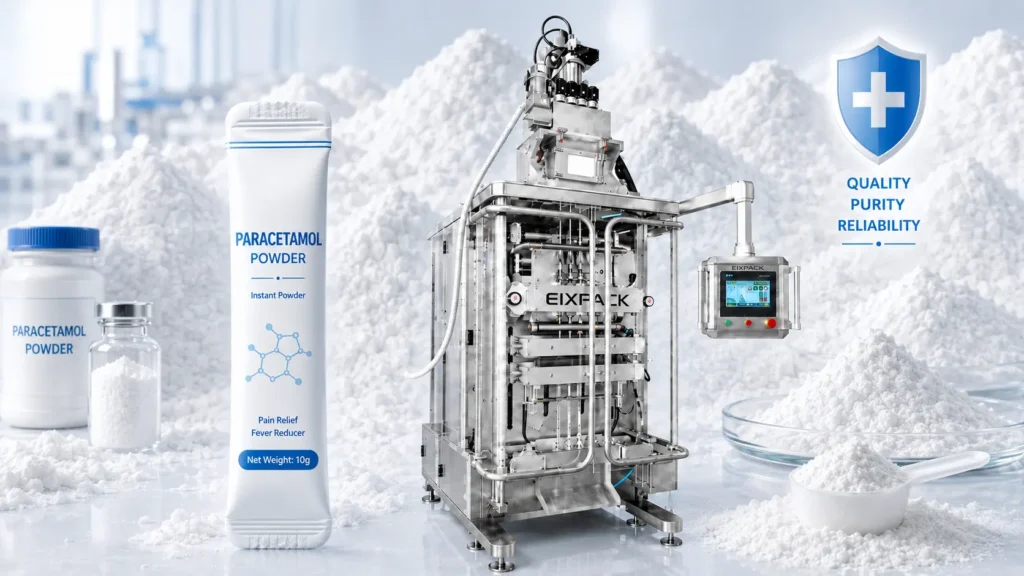
Paracetamol powder stick pack packaging machines should be selected as part of a controlled powder packaging process, not just as a narrow sachet maker. For pharmaceutical companies, OTC powder brands, nutraceutical brands, food brands, and contract manufacturers, the right machine must balance dosing accuracy, dust control, seal quality, cleanability, documentation support, and future automation.
EIXPACK treats paracetamol powder as one application of its powder stick pack machine range, rather than a single-purpose machine category.
In the United States, paracetamol is commonly referred to as acetaminophen, so packaging teams serving the US market should align product naming, labeling, dosage, and quality documentation with the applicable regulatory pathway.
The FDA acetaminophen guidance is a useful reference because it explains that acetaminophen is the US term and that powder is one of its available forms. For Italy and the wider EU market, the same machine decision should also consider GMP expectations, batch traceability, material-contact documentation, and cleaning logic.
Why Paracetamol Powder Is a Demanding Stick Pack Application
Paracetamol powder packaging is demanding because the product may behave differently depending on particle size, bulk density, excipients, sweeteners, flavoring agents, humidity exposure, and upstream blending.
A powder that flows well during a short bench test may bridge in the hopper during a longer production run.
A fine powder may also become airborne during filling and settle near the sealing jaws, where it can weaken the seal or create cosmetic defects.
This is why buyers should not evaluate paracetamol powder stick pack packaging machines by speed alone. A 600 packs/min line may be valuable for a mature high-volume plant, but only if each lane maintains stable dosing, clean sealing, film tracking, coding, rejection, and downstream transfer.
For a new OTC powder launch or a contract manufacturer handling many SKUs, practical changeover and cleaning access may be more valuable than maximum speed.
Selection Matrix for Paracetamol Powder Stick Pack Projects
Use the table below during supplier discussions. It helps separate a machine that can make a sample pack from a packaging system that can support commercial production.
Decision Area |
Recommended Check |
EIXPACK Reference / Action |
Buyer Risk if Ignored |
|---|---|---|---|
Product role | Treat paracetamol powder as one powder application | Configure it under the powder stick pack machine range | Over-specialized or inaccurate machine positioning |
Fill range | 5g–15g powder sticks | Confirm sample, density, and target fill weight | Wrong auger, pouch size, or lane design |
Accuracy | ±0.5g reference accuracy | Confirm during powder testing and FAT | Product giveaway or underfill risk |
Speed | 60–600 packs/min | Match speed to lanes, film, powder, and downstream line | Bottlenecks after primary packaging |
Dust control | Optional dust collector, anti-static, seal-zone separation, stable compressed air | Add based on powder behavior and seal quality tests | Seal contamination and high rejection |
How the Powder Stick Pack Machine Should Handle Dosing, Dust, and Sealing
Dosing is the first technical checkpoint. For 5g to 15g paracetamol powder sticks, the filling system should be selected after reviewing bulk density, flowability, dose tolerance, target speed, and product value.
Servo auger filling is commonly used for fine powders because the screw, hopper, agitation, and product drop can be tuned to the formula.
However, the final decision should be made through sample testing, not assumptions based on a generic powder category.
Dust control is the second checkpoint. EIXPACK can discuss optional dust collection, anti-static treatment, separation between the filling and sealing zones, and stable compressed air configuration where required.
These options are especially relevant for fine powders, high-value formulas, and products that create visible residue around the sealing area.
The goal is not only a clean-looking pack, but also stable seal integrity and fewer rejected sticks.
Sealing performance should be tested with the final film and actual powder.
If powder enters the seal area, the best temperature setting cannot fully compensate for contaminated surfaces.
Buyers should ask how the machine controls product drop timing, film tension, sealing pressure, heat distribution, cutting accuracy, and discharge stability.
A strong seal is the result of product control, film selection, and machine setup working together.
Cleanability and Multi-Product Production
EIXPACK can support pharmaceutical-grade powder, OTC powder, nutraceutical powder, and multi-product production scenarios, but the machine configuration should reflect the cleaning and changeover risk.
A plant running one formula all month has different priorities from a contract manufacturer switching between electrolyte powder, vitamin powder, collagen powder, and OTC powder formats.
In multi-product environments, quick-release hoppers, removable augers, accessible material-contact parts, and clear cleaning support documents become important purchasing criteria.
Material-contact documentation also matters. For regulated or quality-sensitive projects, buyers should request material certificates, contact-part lists, user manuals, FAT documents, and cleaning-related support files as part of the project package.
These documents do not replace the buyer’s own validation work, but they give the quality team better inputs for SOPs, risk assessments, maintenance plans, and production records.
Compliance Considerations for the US and Italy
For the US market, packaging teams should connect the machine decision with the product’s classification, label claims, dosage, batch control, and applicable FDA expectations. The 21 CFR Part 211 equipment requirements are a useful reference for understanding why equipment design, cleaning, maintenance, and contamination prevention matter in finished pharmaceutical manufacturing.
A supplier should not describe a machine as “FDA certified,” because FDA requirements apply to the regulated product and manufacturing process rather than a simple marketing label for the machine.
A safer expression is that the machine can be configured with compliance-oriented design features and documentation support for pharmaceutical stick pack packaging machines.
For Italy and the wider EU market, buyers should think in terms of GMP readiness, traceability, cleaning logic, operator access, and documentation.
The European Commission’s EU GMP guidelines in EudraLex Volume 4 are a relevant external reference for teams evaluating medicinal-product manufacturing expectations in the EU.
If the product is a medicinal product, the expectations will be different from those for a food supplement or sports nutrition powder.
Before confirming the line, define the product category, target country, responsible quality unit, documentation package, and acceptance tests required during FAT.
Secondary Packaging and Line Integration
A stick pack project does not end after primary packaging. Once output increases, manual counting, carton loading, case packing, coding verification, and batch traceability may become the real bottlenecks.
EIXPACK can support integration with coding, rejection, checkweighing, metal detection, cartoning, case packing, traceability, and secondary packaging systems, depending on the final project scope.
Buyers planning future automation can also review EIXPACK’s end-of-line automation solutions before finalizing the primary packaging layout.
This is especially important for contract manufacturers and export-focused brands.
A primary stick pack machine running at 300 or 600 packs/min can quickly overwhelm manual downstream handling.
During quotation, ask whether the proposed line includes discharge counting, reject confirmation, carton synchronization, buffer design, and space for future automation.
Even when the first purchase is only a powder stick pack machine, the layout should not block future scale-up.
Common Buying Mistakes
The first mistake is buying by maximum speed. Speed only matters if the powder, film, dosing system, sealing system, and downstream equipment can remain stable at that output.
The second mistake is ignoring powder testing.
A quotation based only on product name is not enough for paracetamol powder, especially when the final formula includes sweeteners, flavors, granulation differences, or moisture-sensitive ingredients.
The second mistake is asking for a low price before defining the process. Price depends on lane count, dosing configuration, dust control options, coding, rejection, checkweigher, metal detector, cartoner, case packer, traceability needs, documentation package, and factory acceptance testing.
A clear quotation request should describe the powder, fill weight, pouch size, film, target speed, sales market, cleaning expectations, and downstream automation plan.
Where EIXPACK Fits in the Buying Process
EIXPACK can help buyers compare a powder stick pack machine configuration against wider stick pack machine options, including requirements for powder handling, cleanability, documentation, and secondary packaging.
For paracetamol powder projects, the discussion should begin with product samples, target fill weight, 5g to 15g packaging requirements, expected speed range, preferred lane count, film structure, and the destination market.
The safest next step is not to ask for a generic machine price, but to request a custom machine layout and FAT plan based on the actual powder. For a US electrolyte powder brand, an Italian supplement company, a European contract manufacturer, or an OTC powder project, the right configuration may be different.
A well-prepared request helps EIXPACK recommend the right lane count, optional dust control, coding and inspection setup, and downstream automation path.
Final Purchasing Advice
A reliable paracetamol powder stick pack line starts with product behavior and ends with a scalable packaging process. Confirm the powder first, then the stick size, film, dosing method, dust control, cleaning access, documentation, and automation layout.
The right paracetamol powder stick pack packaging machines should protect dose consistency, reduce seal contamination, support quality documentation, and leave room for future growth.
Frequently Asked Questions (FAQ)
They are used to form, fill, seal, cut, code, and discharge single-dose powder sticks for paracetamol or acetaminophen powder products, depending on the target market and product classification.
For paracetamol powder applications, the reference fill range is 5g–15g. The final configuration should be confirmed by powder testing, film testing, and FAT requirements.
The confirmed reference accuracy is ±0.5g, depending on product behavior and test conditions. Buyers should confirm the acceptance criteria before FAT.
Yes, EIXPACK can support these multi-product scenarios, but the final machine should include suitable cleaning access, changeover design, documentation, and optional dust control where needed.
Choose lane count based on daily output, powder behavior, operator skill, downstream automation, and maintenance capacity. More lanes increase output but also require stronger process control.
Prepare the powder sample, bulk density, target fill weight, stick size, film structure, target speed, sales market, cleaning expectations, and downstream automation needs.
Quick Quote Request
Share your paracetamol powder formula, 5g–15g stick size, target speed, preferred lane count, film structure, and compliance documentation needs with EIXPACK.
Our team can help you compare powder stick pack machine configurations and plan a scalable stick pack line for US, Italy, or wider export markets.